A domestic breed
Icelandic Sheepdog
Canis lupus familiaris
Iceland’s native farm dog
Branches show genetic similarity, not direct ancestors or dated splits. Crossbreeding connects different branches.
Return to the tree of life →Iceland’s only recognised native dog breed grew out of farm dogs that worked in pastures and on mountain slopes. Those dogs were part of rural life long before the modern breed was registered.
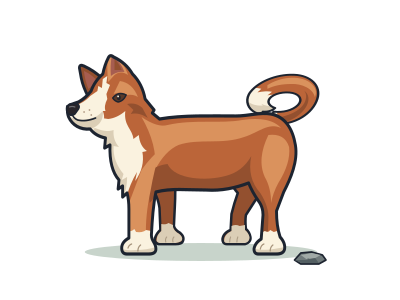
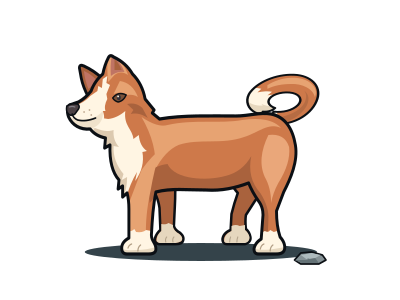
An adult is sturdy, with upright ears, a strong muzzle and a bushy tail that curls over its back. The coat comes in shorter and longer forms. Some dogs have naturally dark fur on the face.
Researchers compared DNA from about 1,350 dogs and put both breeds in the same Nordic spitz group. That’s why they sit beside each other here. Their places in this diagram do not show that one breed came from the other or tell us when breeds split.
Origins
Breeders rebuilt the modern breed from a small number of dogs. In 1967, Sigríður Pétursdóttir started a breeding programme at Ólafsvellir farm in Iceland with help from Páll A. Pálsson. She later brought in two dogs from Mark Watson’s breeding programme in England.
Original purpose
Icelandic farmers used these dogs to round up sheep and ponies. The dogs also helped find sheep lost in snowdrifts.
Recognition
The Fédération Cynologique Internationale (FCI) granted the breed full recognition on 17 July 1972. That was the organisation’s decision, not the date the breed began.
Study attribution
Parker et al. (2017), Cell Reports 19:697–708 · CC-BY-4.0. Selected clade membership and nested Figure 1 relationships restated as a new, simplified diagram. No photographs, branch lengths or bootstrap values copied.
Selected facts/group membership adapted; simplified layout and illustrations by Lifetree.