A domestic breed
Portuguese Water Dog
Canis lupus familiaris
A fishing dog with a Poodle connection
Branches show genetic similarity, not direct ancestors or dated splits. Crossbreeding connects different branches.
Return to the tree of life →Working dogs once helped fishers along Portugal’s coast. As fishing methods changed, the dogs were found mainly in the Algarve, in southern Portugal. Breeders drew on these coastal working dogs to develop the modern breed.
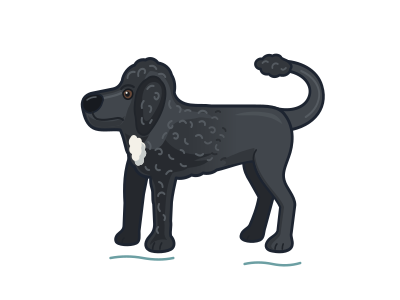
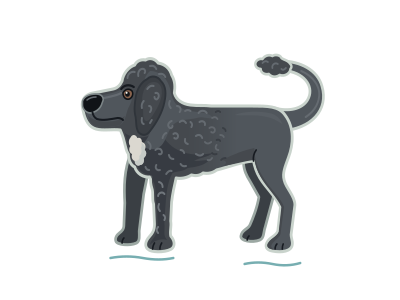
A typical adult has a sturdy build, a deep chest and a broad head with a strong, straight muzzle. Its rounded paws have webbing between the toes, and its tapering tail helps it swim and dive. Look for either long, loose waves or shorter, tight curls. Both are natural coat types.
The exhibit puts this breed beside the Standard Poodle and the Bichon Frise because of similarities in their DNA. The diagram doesn’t show one breed as the ancestor of another, identify past crosses or give dates for splits. The 2017 study found evidence of crosses even between breeds in different groups.
Origins
A fishing-boat dog named Leão became the model for the first written breed standard. Vasco Bensaúde’s kennel recorded its first litter in 1937.
Original purpose
Portuguese fishers used the dogs to drive schools of fish into nets, retrieve lost nets and carry messages between boats.
Recognition
The international dog federation (FCI) formally recognised the breed in 1955. That marks official recognition, not the breed’s beginning.
Study attribution
Parker et al. (2017), Cell Reports 19:697–708 · CC-BY-4.0. Selected clade membership and nested Figure 1 relationships restated as a new, simplified diagram. No photographs, branch lengths or bootstrap values copied.
Selected facts/group membership adapted; simplified layout and illustrations by Lifetree.