A domestic breed
Havanese
Canis lupus familiaris
A small Bichon-family dog with flowing hair and a springy step.
Branches show genetic similarity, not direct ancestors or dated splits. Crossbreeding connects different branches.
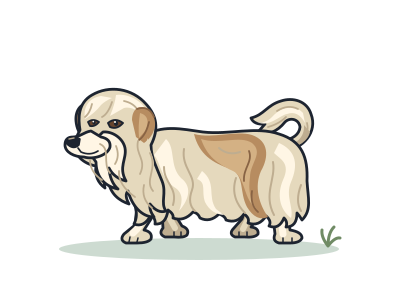
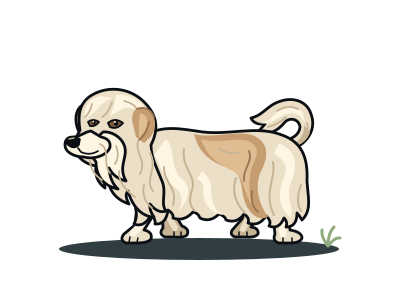
Return to the tree of life →The Havanese belongs to the traditional Bichon family of small dogs. Its recognisable outline combines a sturdy body, slightly longer than tall, with long, soft, wavy hair. Its ears fold down, and its tail arches over the back with a plume of silky hair. Beneath the facial hair is a substantial muzzle, not a flattened face.
Its documented development includes an American breeding programme established by Dorothy and Bert Goodale in the 1970s. They used dogs obtained from Cuban emigrant families. This was a chapter in the breed’s history, not its beginning. Its earliest history is less completely recorded.
Here, it appears beside the Standard Poodle, Bichon Frise and Maltese, grouped by similarities found in one study. The neighbouring positions do not establish which breeds contributed to another’s development. The Poodle group is a way to browse this tree, not a claim that the Havanese descended from a modern Poodle.
Origins
The international dog registry FCI officially lists Cuba as the breed’s country of origin.
Original purpose
These dogs were companions and children’s playmates in wealthy Cuban households.
Recognition
The American Kennel Club lists recognition in 1996. This is a registry milestone, not the breed’s origin date.
Study attribution
Parker et al. (2017), Cell Reports 19:697–708 · CC-BY-4.0. Selected clade membership and nested Figure 1 relationships restated as a new, simplified diagram. No photographs, branch lengths or bootstrap values copied.
Selected facts/group membership adapted; simplified layout and illustrations by Lifetree.