A domestic breed
Newfoundland
Canis lupus familiaris
An island working dog shaped on both sides of the Atlantic
Branches show genetic similarity, not direct ancestors or dated splits. Crossbreeding connects different branches.
Return to the tree of life →Breeders in England helped shape the modern Newfoundland from working dogs brought over from the island. In 1860, six Newfoundlands were entered at a dog show in Birmingham, England.
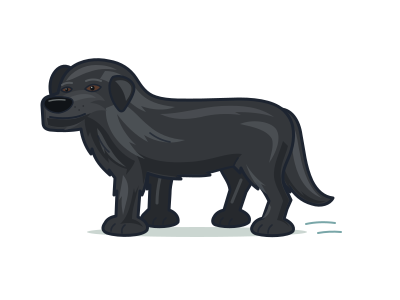
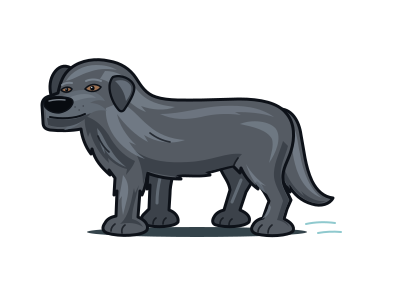
A typical adult is heavily built, with a deep chest, a broad head and a square snout. Its eyes are set wide apart, and its rounded triangular ears hang close to its head. Its thick coat resists water. It has webbed toes and a thick tail that helps it steer as it swims. When the dog stands at ease, its tail hangs to about the ankle of a back leg.
A 2017 study compared dogs’ DNA and grouped the Newfoundland with retrievers. This exhibit shows part of that group, including the Labrador, Golden and Flat-Coated Retrievers. The branches show similarities among the dogs studied, not direct descent from one breed to another. The branches are not dated, and they leave out past crosses that the study found between some breeds.
Origins
The breed takes its name from the Canadian island of Newfoundland. That name was already in use by the late 1700s.
Original purpose
Newfoundland dogs helped fishers haul nets ashore and pulled carts carrying the catch to market.
Recognition
The American Kennel Club recognised the Newfoundland in 1886. The breed was already known before then.
Study attribution
Parker et al. (2017), Cell Reports 19:697–708 · CC-BY-4.0. Selected clade membership and nested Figure 1 relationships restated as a new, simplified diagram. No photographs, branch lengths or bootstrap values copied.
Selected facts/group membership adapted; simplified layout and illustrations by Lifetree.