A domestic breed
Nova Scotia Duck Tolling Retriever
Canis lupus familiaris
A red-coated retriever with roots in Nova Scotia’s working dogs.
Branches show genetic similarity, not direct ancestors or dated splits. Crossbreeding connects different branches.
Return to the tree of life →A Toller can look like a small Golden Retriever at first glance. But it is a distinct breed, not a miniature Golden Retriever.
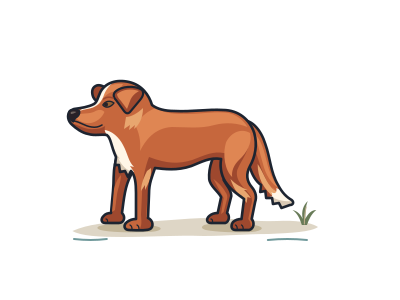
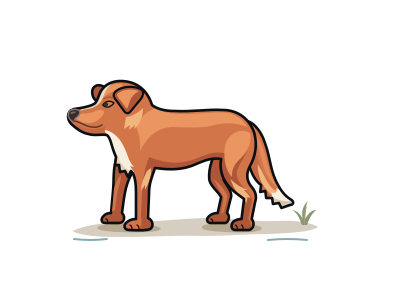
A typical adult Toller is compact and muscular, with a deep chest, a muzzle that narrows towards the nose and triangular ears that fold down. Its coat ranges from orange to red, with a soft, dense layer beneath the water-repelling outer fur. Look for longer fur on the tail and sometimes a splash of white on the chest, face, feet or tail tip.
The diagram places the Toller beside the Curly-Coated Retriever and a branch that includes the Newfoundland. The branches group dogs by similarities in their DNA. They don’t show one neighbouring breed as the ancestor of another or tell us when breeds split. Crossbreeding can link dogs on different branches.
Origins
The breed developed in Little River Harbour, in Nova Scotia’s Yarmouth County, during the 1800s. One of its earlier names was the Little River Duck Dog.
Original purpose
The dog played fetch with a stick or ball along the shore to draw curious ducks closer. This was the tolling part. The dog then swam out to bring back a duck the hunter had shot.
Recognition
The Canadian Kennel Club formally recognised the breed under its current name in 1945.
Study attribution
Parker et al. (2017), Cell Reports 19:697–708 · CC-BY-4.0. Selected clade membership and nested Figure 1 relationships restated as a new, simplified diagram. No photographs, branch lengths or bootstrap values copied.
Selected facts/group membership adapted; simplified layout and illustrations by Lifetree.