A domestic breed
Labrador Retriever
Canis lupus familiaris
A sturdy dog breed with a distinctive otter-like tail.
Branches show genetic similarity, not direct ancestors or dated splits. Crossbreeding connects different branches.
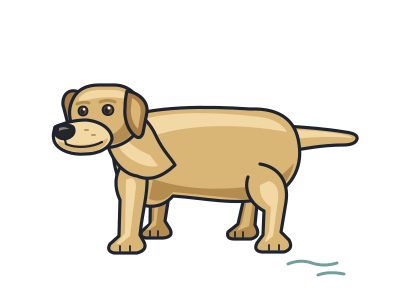
Return to the tree of life →The Labrador Retriever is a sturdy, compact dog breed with a broad head, deep chest and strong back legs. Here it sits beside Golden, Flat-Coated and Curly-Coated Retrievers. These neighbours belong to a grouping based on genetic similarities found in one study. Their placement does not show Labrador parentage or the direction of any historical crosses.
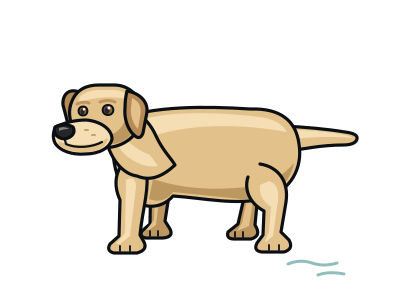
Its coat is short and dense, with a weather-resistant layer underneath. The standard colours are black, yellow and chocolate brown. Yellow can range from pale cream to fox red, while chocolate ranges from light to dark brown. A yellow Labrador is still a Labrador, not a Golden Retriever.
Look closely at the tail. Thick at the base and narrowing towards the tip, it has a rounded outline like an otter’s tail. There is no long fringe of hair. Hanging ears and brown or hazel eyes complete the recognisable breed form described by breed standards.
Origins
The breed’s roots lie in Newfoundland, Canada. Dogs brought to Britain from fishing boats in the early 1800s were further developed there, according to the Canadian Kennel Club.
Original purpose
The breed’s early working ancestors helped Newfoundland fishers haul fishing nets ashore. In Britain, breeding programmes developed these dogs to bring back ducks during hunts.
Recognition
The American Kennel Club recognised the breed in 1917. This marked acceptance for official registration, not the breed’s beginning.
Study attribution
Parker et al. (2017), Cell Reports 19:697–708 · CC-BY-4.0. Selected clade membership and nested Figure 1 relationships restated as a new, simplified diagram. No photographs, branch lengths or bootstrap values copied.
Selected facts/group membership adapted; simplified layout and illustrations by Lifetree.