A domestic breed
Golden Retriever
Canis lupus familiaris
A familiar golden coat, with a documented Scottish history.
Branches show genetic similarity, not direct ancestors or dated splits. Crossbreeding connects different branches.
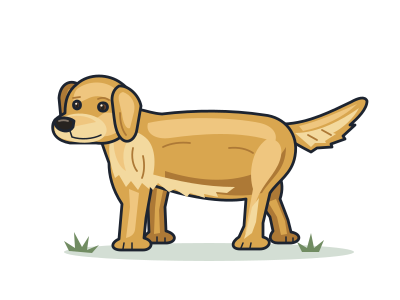
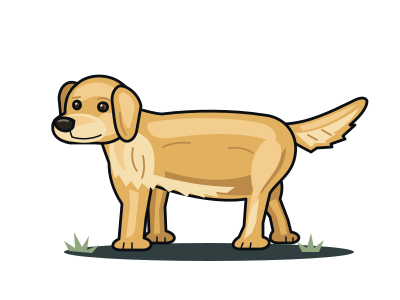
Return to the tree of life →The Golden Retriever’s familiar outline combines a broad head, substantial muzzle and level back. Its powerful body carries a coat that can be straight or wavy, with a dense layer of fur underneath that helps resist water. Longer fringes grow along the chest, belly, backs of the legs and underside of the tail. Its ears hang close to its cheeks, and its long tail does not curl over its back.
Here, the Golden Retriever sits beside Labrador, Flat-Coated and Curly-Coated Retrievers in a study-specific grouping based on genetic similarity. This is not a pedigree: a record of parents and offspring. Neighbouring breeds are not shown as ancestors and descendants, and browsing groups are not direct ancestors. The diagram gives no dates for breeds branching apart, and its lines do not measure time. Historical breeding records and this similarity diagram answer different questions.
Origins
Documented development centres on Lord Tweedmouth’s Guisachan estate in Scotland. His records describe crossing Nous, a yellow retriever, with Belle, a Tweed Water Spaniel.
Original purpose
Golden Retrievers were developed to bring back birds shot by hunters, both from water and from drier ground.
Recognition
The American Kennel Club recognised the breed in 1925. This was a registry milestone, not its origin.
Study attribution
Parker et al. (2017), Cell Reports 19:697–708 · CC-BY-4.0. Selected clade membership and nested Figure 1 relationships restated as a new, simplified diagram. No photographs, branch lengths or bootstrap values copied.
Selected facts/group membership adapted; simplified layout and illustrations by Lifetree.