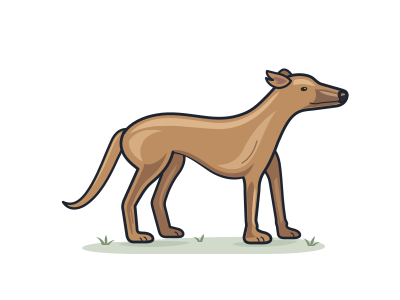
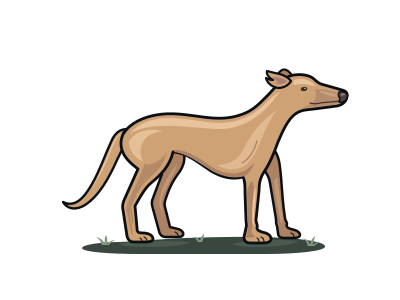
A domestic breed
Greyhound
Canis lupus familiaris
A tall British breed with a smaller lookalike: the Whippet.
Branches show genetic similarity, not direct ancestors or dated splits. Crossbreeding connects different branches.
Return to the tree of life →The Greyhound has long legs, a deep chest and a long head. It has much the same outline as a Whippet, but stands taller. Look for the small ears that fold back at rest and the long tail that hangs in a slight curve.
In the 2017 study behind this exhibit, Greyhounds and Whippets fell within a wider group the researchers called UK Rural. That group also included dogs bred to herd sheep, such as the Shetland Sheepdog.
The branches don’t show one breed as the direct ancestor of another or tell us when breeds split. The researchers also found evidence that dogs from different groups were bred together. Those links can cross branches, so the diagram shows only part of the breeds’ history.
Origins
Britain’s National Coursing Club created the first Greyhound Stud Book in 1882. It set up a closed register of family lines for dogs used in coursing. Greyhound-like dogs existed long before the register.
Original purpose
Greyhounds were bred to spot and chase animals such as hares rather than follow a scent. This kind of hunt was called coursing.
Recognition
The Fédération Cynologique Internationale gave the Greyhound full recognition in 1955. That date records an official decision, not when the breed began.
Study attribution
Parker et al. (2017), Cell Reports 19:697–708 · CC-BY-4.0. Selected clade membership and nested Figure 1 relationships restated as a new, simplified diagram. No photographs, branch lengths or bootstrap values copied.
Selected facts/group membership adapted; simplified layout and illustrations by Lifetree.