A domestic breed
English Cocker Spaniel
Canis lupus familiaris
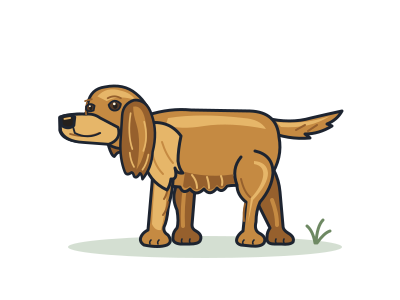
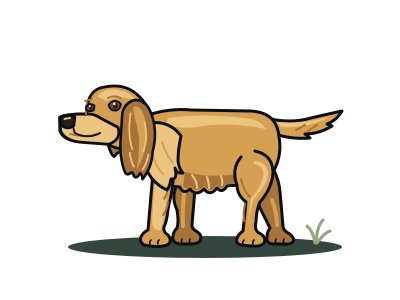
Long, silky ears and a compact spaniel shape
Branches show genetic similarity, not direct ancestors or dated splits. Crossbreeding connects different branches.
Return to the tree of life →Long, silky ears frame the English Cocker Spaniel’s substantial, square muzzle. Its compact body is about as tall at the shoulder as it is long from shoulder to tail base. The ears start around eye level, with flaps long enough to reach the nose tip. These features help make its familiar spaniel shape recognisable.
That modern shape emerged through breed development, not a neat sequence of separate breeds. Earlier spaniels used on land were bred together and sorted by size and colour. Today’s breed boundaries should not be projected backwards onto those earlier dogs.
Here, the English Cocker sits alongside other spaniels in a grouping based on one study’s genetic similarities. This is not a pedigree: neighbouring breeds are not shown as ancestors and descendants. That limitation does not rule out documented historical crosses or development from earlier breed stock. The layout gives no dates for separations between breeds.
Origins
The English Cocker Spaniel is a domestic dog breed from Great Britain, not a separate species.
Original purpose
These dogs were bred to help hunters find woodcock, a kind of bird. This work gave the breed its name.
Recognition
The American Kennel Club recognised the English Cocker Spaniel as a separate breed in 1946. This was a registry decision, not its origin date.
Study attribution
Parker et al. (2017), Cell Reports 19:697–708 · CC-BY-4.0. Selected clade membership and nested Figure 1 relationships restated as a new, simplified diagram. No photographs, branch lengths or bootstrap values copied.
Selected facts/group membership adapted; simplified layout and illustrations by Lifetree.