A domestic breed
Cavalier King Charles Spaniel
Canis lupus familiaris
A small spaniel with silky ears and a carefully restored look
Branches show genetic similarity, not direct ancestors or dated splits. Crossbreeding connects different branches.
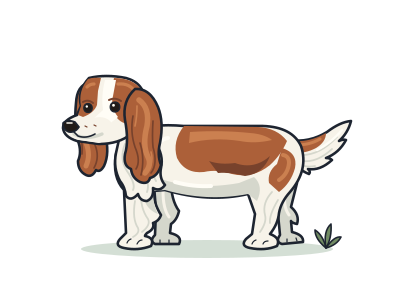
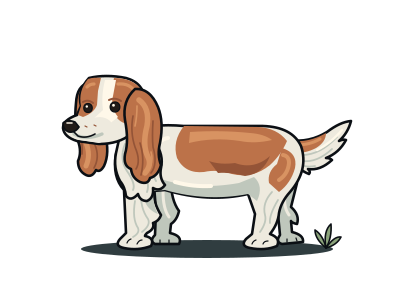
Return to the tree of life →Long, silky ears frame the Cavalier King Charles Spaniel’s face. This small dog is a separate breed from the similarly named King Charles Spaniel: the Cavalier has a longer muzzle and a flatter-looking head. A typical adult’s body is slightly longer than its shoulder height, with a level back and straight front legs.
The breed standard describes a silky coat without curls, though a slight wave is allowed. Longer fringes grow on the ears, chest, legs, feet and tail. Four traditional colour patterns give Cavaliers quite different looks: chestnut and white, black and white with tan markings, solid red, or black and tan.
Here, the Cavalier sits beside Cocker and Springer spaniels in a study-specific similarity grouping. That layout is not a pedigree—a record of parents and earlier ancestors. Neighbouring breeds are not shown as ancestors and descendants, and browsing groups are not direct ancestors. The diagram gives no dates for breed splits, and its spacing does not measure time or genetic difference. Documented breed development is a separate history; the layout alone cannot establish it.
Origins
The modern breed was developed in Britain in the 1920s to recover the longer-faced toy-spaniel appearance shown in old paintings.
Original purpose
Cavaliers were developed as companions and lap dogs, continuing the tradition of small spaniels kept by British royalty and noble households.
Recognition
Britain’s Kennel Club granted separate breed registration in 1945. This was a registry milestone, not the start of the breed’s development.
Study attribution
Parker et al. (2017), Cell Reports 19:697–708 · CC-BY-4.0. Selected clade membership and nested Figure 1 relationships restated as a new, simplified diagram. No photographs, branch lengths or bootstrap values copied.
Selected facts/group membership adapted; simplified layout and illustrations by Lifetree.