A domestic breed
English Springer Spaniel
Canis lupus familiaris
Long ears, fringed fur and a shared spaniel history.
Branches show genetic similarity, not direct ancestors or dated splits. Crossbreeding connects different branches.
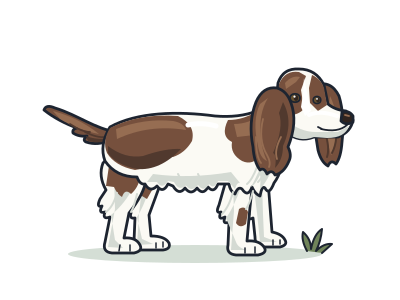
Return to the tree of life →Long, hanging ears and fringes of hair on the legs and underside help make the English Springer Spaniel recognisable. Its coat is usually brown and white or black and white, sometimes with tan markings. Dark hazel eyes and compact, rounded feet are also part of the British breed description.
Its connection with cocker spaniels has a surprising history. Before modern breed boundaries, smaller dogs called cockers and larger dogs called springers could come from the same litter. That does not mean today's English Springer descends from today's English Cocker. Selection for different competitions has also shaped its appearance: dogs bred for shows and those bred for field work can look different.
Here it sits beside other spaniel breeds, grouped by genetic similarity in one study. This is not a pedigree. Neighbouring positions do not show that one breed descended from another. The larger browsing groups are not direct ancestors either. No dates of separation are implied, and branch lengths carry no meaning here. Historical records can document crosses or development from earlier breeds. This layout alone cannot confirm or rule out that history.
Origins
The breed developed in England. Breed histories report an early breeding line in Shropshire around 1800, but this is not an exact birthday for the breed.
Original purpose
These dogs found animals hidden in cover and made them emerge for hunters using nets, falcons or greyhounds. Later, they also worked with hunters using guns.
Recognition
Britain's Kennel Club recognised the breed in 1902. The first American Kennel Club registration followed in 1910. Neither date marks its origin.
Study attribution
Parker et al. (2017), Cell Reports 19:697–708 · CC-BY-4.0. Selected clade membership and nested Figure 1 relationships restated as a new, simplified diagram. No photographs, branch lengths or bootstrap values copied.
Selected facts/group membership adapted; simplified layout and illustrations by Lifetree.