A domestic breed
American Cocker Spaniel
Canis lupus familiaris
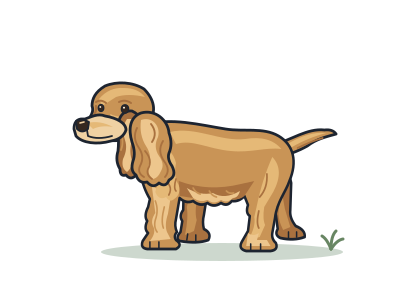
Long ears, a rounded head and a sturdy frame.
Branches show genetic similarity, not direct ancestors or dated splits. Crossbreeding connects different branches.
Return to the tree of life →The American Cocker Spaniel is a compact, sturdy dog breed, recognisable by its rounded head and long, hanging ears. Those ears sit low on the head and carry silky hair. Beneath the coat are strong legs and a deep chest, with a back that slopes gently towards the tail.
Look closely at the eyes: their rims give them a slightly almond-shaped outline. The British standard describes a natural tail of moderate length, narrowing towards its tip and carried along the line of the back or slightly higher. These dogs do not all have short tails.
Here it appears alongside the English Cocker, Cavalier King Charles and English Springer spaniels. This diagram groups breeds by genetic similarity measured in one study. Neighbours are not shown as ancestors and descendants, and browsing groups are not direct ancestors. That does not rule out documented breed development from earlier dogs. The layout gives no dates for when breeds separated.
Origins
The breed developed in the United States from imported cocker-spaniel stock. By the 1920s, some American breeders were selecting shorter muzzles, rounder heads and fuller coats.
Original purpose
Cockers inherited a bird-hunting role: helping hunters find birds, make them leave hiding places and bring them back. This was separate from later selection for appearance.
Recognition
In 1946, the American Kennel Club recognised the English Cocker Spaniel separately from the American breed. This distinguished two existing types; it was not the American breed’s origin date.
Study attribution
Parker et al. (2017), Cell Reports 19:697–708 · CC-BY-4.0. Selected clade membership and nested Figure 1 relationships restated as a new, simplified diagram. No photographs, branch lengths or bootstrap values copied.
Selected facts/group membership adapted; simplified layout and illustrations by Lifetree.