A domestic breed
Bernese Mountain Dog
Canis lupus familiaris
A long-coated farm dog with a three-coloured look
Branches show genetic similarity, not direct ancestors or dated splits. Crossbreeding connects different branches.
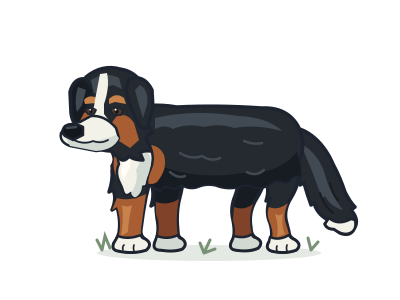
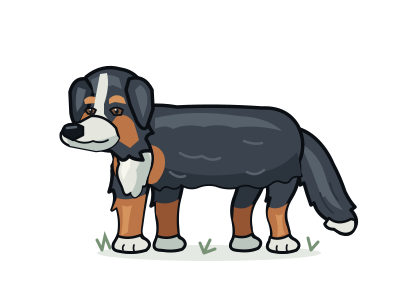
Return to the tree of life →The Bernese Mountain Dog is recognisable by its long black coat, rust-coloured patches and white markings. A white stripe runs down the forehead towards the muzzle, with more white on the chest. Adults have sturdy legs and a body slightly longer than it is tall. At rest, their triangular ears hang beside the head rather than standing upright.
In 1907, breeders around Burgdorf formed a club and set out the breed’s characteristic features. An earlier name, Dürrbächler, came from Dürrbach, a small village and inn where these dogs were especially numerous. At a Burgdorf show in 1910, about 100 dogs were shown, many brought by local farmers.
Here, it sits beside the Saint Bernard in a grouping based on similarities found in one genetic study. That position does not show either breed as the other’s ancestor or descendant. The browsing groups are not direct ancestors, and the branches imply no split dates or measured distances. Breed development also involved crossings that a simple branching diagram cannot fully show.
Origins
The breed developed from farm dogs around Bern in Switzerland, including the foothills and nearby midland countryside.
Original purpose
The American breed club describes its central role as a farmer’s companion and watchdog, alerting the household to unfamiliar visitors.
Recognition
The American Kennel Club recognised the breed in 1937. This marks entry into that registry, not the breed’s origin.
Study attribution
Parker et al. (2017), Cell Reports 19:697–708 · CC-BY-4.0. Selected clade membership and nested Figure 1 relationships restated as a new, simplified diagram. No photographs, branch lengths or bootstrap values copied.
Selected facts/group membership adapted; simplified layout and illustrations by Lifetree.