A domestic breed
Saint Bernard
Canis lupus familiaris
A giant dog with a documented mountain history
Branches show genetic similarity, not direct ancestors or dated splits. Crossbreeding connects different branches.
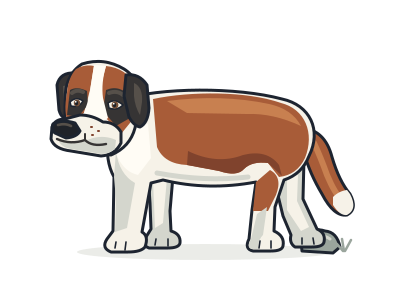
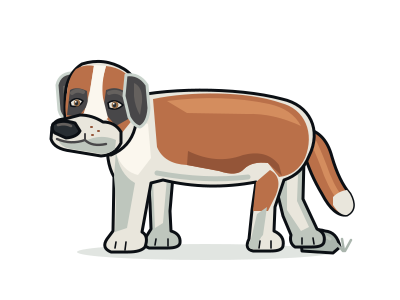
Return to the tree of life →The Saint Bernard is recognisable by its broad head, substantial square-ended muzzle and sturdy adult build. Its white coat has red or reddish-brown patches. Both short-haired and long-haired varieties are recognised, and both have a thick layer of fur beneath the outer coat. This is a domestic dog breed, not a separate species.
Its familiar form developed through generations of selection from large local farm dogs. Pictures dated 1695 and a written record from 1707 document dogs at the hospice. Later, Heinrich Schumacher began issuing ancestry documents for his dogs in 1867. These records help separate documented breed development from stories about much earlier ancestry.
On this tree, the Saint Bernard sits beside the Bernese Mountain Dog in the study’s Alpine grouping. That makes them neighbours in a particular comparison of breeds, not links in a parent-to-offspring chain. The diagram does not establish that either breed descended from the other. Documented breed history is separate evidence; this layout supplies neither dates for splits nor meaningful branch lengths.
Origins
The breed developed around the Great Saint Bernard Hospice in the Swiss Alps, beside the mountain pass between Switzerland and Italy.
Original purpose
Large mountain dogs initially guarded the hospice and its visitors. They later helped find travellers lost in snow and fog.
Recognition
FCI, an international federation of dog organisations, formally recognised the breed on 28 August 1954. This was a recognition milestone, not its origin date.
Study attribution
Parker et al. (2017), Cell Reports 19:697–708 · CC-BY-4.0. Selected clade membership and nested Figure 1 relationships restated as a new, simplified diagram. No photographs, branch lengths or bootstrap values copied.
Selected facts/group membership adapted; simplified layout and illustrations by Lifetree.