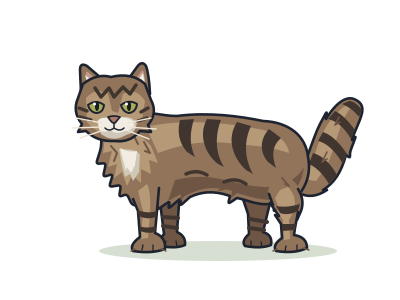
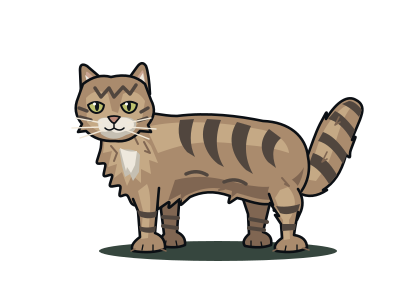
A domestic breed
Siberian
Felis catus
A thick-coated domestic breed, not a wild forest cat.
These are editorial browsing groups, informed by Gandolfi et al. 2018 genetic-structure analyses. They are not rooted clades, direct ancestry, or a map of breed origins. Admixture and incomplete sampling limit every grouping.
Return to the tree of life →The Siberian is a domestic-cat breed with a thick, three-layered coat—not a separate wild forest species. Females are normally smaller than males, but the breed’s characteristic build matters more than sheer size. Its place beside other breeds here is a browsing choice, not a family tree.
Some early cats used to establish the breed had the desired appearance but unknown parents. Over generations, their descendants built up recorded family histories. The earlier name, Siberian Forest Cat, was shortened to avoid confusion with the Norwegian Forest Cat. Elizabeth Terrell brought three Siberians from Russia to the United States in 1990.
This diagram uses editorial groups informed by a study of genetic similarities. Neighbouring breeds are not thereby shown to be ancestors, descendants or sister groups. Nor does their position map where breeds originated. Mixed ancestry and incomplete sampling limit the picture. The diagram neither proves nor rules out particular historical crosses; those need separate evidence.
Origins
The breed developed from local Russian cats. Organised pedigree breeding began in the late 1980s, and not every founding cat necessarily came from Siberia itself.
Original purpose
Before becoming show cats, these cats helped farmers and tradespeople by catching rodents.
Recognition
The International Cat Association accepted Siberians into its New Breed programme in 1992 and granted championship status in 1996. These are registry milestones, not origin dates.
Study attribution
Gandolfi et al. (2018), Scientific Reports 8:7024 · CC-BY-4.0. Original explanation of study-specific similarity; editorial group headings are explicitly not clades or geography of origin. No study photos imported.
CFA, TICA and GCCF breed histories. Original summaries of documented breeding programmes and registry distinctions. Per-page sources identify the relevant breed histories; no standards, source prose or photographs reproduced.
Gandolfi et al. (2010): Sphynx and Devon Rex mutations in KRT71. Independent factual explanation of distinct coat variants, not a breed pedigree. No source imagery or text reproduced.
Selection Signatures Reveal Candidate Genes for the Cornish Rex Breed-Specific Phenotype (2024). Factual contrast between LPAR6-associated Cornish coat and KRT71-associated Devon/Sphynx coats. No figures or measurements copied.
Selected facts/group membership adapted; simplified layout and illustrations by Lifetree.