A domestic breed
Ragdoll
Felis catus
One domestic cat species, many breed identities.
These are editorial browsing groups, informed by Gandolfi et al. 2018 genetic-structure analyses. They are not rooted clades, direct ancestry, or a map of breed origins. Admixture and incomplete sampling limit every grouping.
Return to the tree of life →The Ragdoll is a domestic cat breed, sharing its species with every other breed shown here. Its neighbours include the Maine Coon and Siberian, but their positions do not establish a special family relationship. Even sharing long hair does not prove that two breeds are each other’s closest relatives.
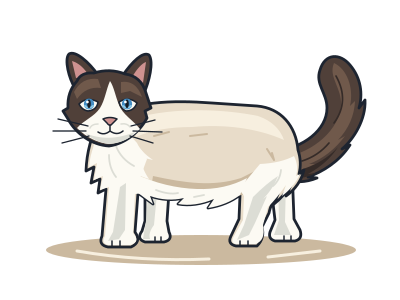
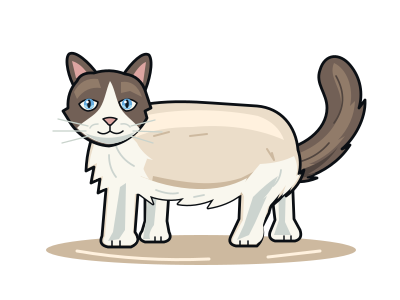
A Ragdoll’s colouring usually contrasts a lighter body with darker fur on the face, ears, legs and tail. White markings can cover some of those darker areas. Patterns differ: some cats have white feet, while others have a white upside-down V on the face. Pointed kittens are born white, with darker markings beginning to appear within days.
This exhibit uses editorial browsing groups informed by a study of genetic similarity. It is not a map of where breeds began, and neighbouring breeds are not shown as ancestors and descendants. That limitation does not rule out documented historical crosses or development from earlier breed stock; those histories need their own evidence.
Origins
Ann Baker developed the Ragdoll in Riverside, California, during the 1960s.
Original purpose
Baker selected domestic longhaired cats to create a breed with the appearance and character she wanted.
Recognition
The International Cat Association accepted Ragdolls for championship competition when it began in June 1979. This was a recognition date, not the breed’s origin.
Study attribution
Gandolfi et al. (2018), Scientific Reports 8:7024 · CC-BY-4.0. Original explanation of study-specific similarity; editorial group headings are explicitly not clades or geography of origin. No study photos imported.
CFA, TICA and GCCF breed histories. Original summaries of documented breeding programmes and registry distinctions. Per-page sources identify the relevant breed histories; no standards, source prose or photographs reproduced.
Gandolfi et al. (2010): Sphynx and Devon Rex mutations in KRT71. Independent factual explanation of distinct coat variants, not a breed pedigree. No source imagery or text reproduced.
Selection Signatures Reveal Candidate Genes for the Cornish Rex Breed-Specific Phenotype (2024). Factual contrast between LPAR6-associated Cornish coat and KRT71-associated Devon/Sphynx coats. No figures or measurements copied.
Selected facts/group membership adapted; simplified layout and illustrations by Lifetree.