A domestic breed
Russian Blue
Felis catus
A silver-grey cat with an international breeding history.
These are editorial browsing groups, informed by Gandolfi et al. 2018 genetic-structure analyses. They are not rooted clades, direct ancestry, or a map of breed origins. Admixture and incomplete sampling limit every grouping.
Return to the tree of life →The Russian Blue is a domestic cat breed, not a separate species. Breeders in Britain, Scandinavia and North America helped develop the modern breed. After the Second World War, some breeders crossed Russian Blues with British Shorthairs or Siamese while rebuilding their breeding lines. North American breeders also combined cats from English and Scandinavian lines.
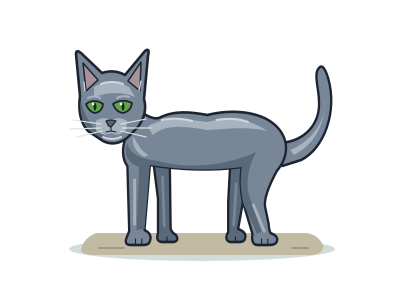
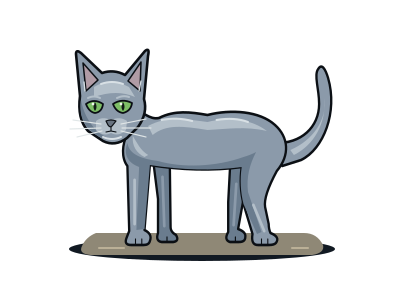
Here, “blue” means grey, not bright blue. Silver tips on the outer hairs give the coat a shimmering finish. The short fur is unusually dense and stands away from the body. Beneath it is a long, muscular cat with slender legs and a long, tapering tail. Adult show standards call for vivid green eyes and an evenly coloured coat without stripes.
Its neighbours in this explorer are browsing companions. Their positions do not establish ancestors, descendants or each other’s closest relatives. These editorial groups draw on research into genetic similarity. They do not show a chain of descent or where breeds began. Past mixing between populations and gaps in the study’s coverage limit what the groupings can show. Documented historical crosses are separate evidence about breed development.
Origins
Tradition links the breed to the Archangel region of northern Russia, but its early origin is not securely documented.
Original purpose
Its original role is uncertain. A Cats NSW history recounts a belief that sailors carried these cats as companions, rather than presenting this as proven history.
Recognition
The breed gained its own British show class in 1912, after competing alongside other blue cats. This was a recognition milestone, not an origin date.
Study attribution
Gandolfi et al. (2018), Scientific Reports 8:7024 · CC-BY-4.0. Original explanation of study-specific similarity; editorial group headings are explicitly not clades or geography of origin. No study photos imported.
CFA, TICA and GCCF breed histories. Original summaries of documented breeding programmes and registry distinctions. Per-page sources identify the relevant breed histories; no standards, source prose or photographs reproduced.
Gandolfi et al. (2010): Sphynx and Devon Rex mutations in KRT71. Independent factual explanation of distinct coat variants, not a breed pedigree. No source imagery or text reproduced.
Selection Signatures Reveal Candidate Genes for the Cornish Rex Breed-Specific Phenotype (2024). Factual contrast between LPAR6-associated Cornish coat and KRT71-associated Devon/Sphynx coats. No figures or measurements copied.
Selected facts/group membership adapted; simplified layout and illustrations by Lifetree.