A domestic breed
Norwegian Forest Cat
Felis catus
A domestic cat with a thick winter wardrobe.
These are editorial browsing groups, informed by Gandolfi et al. 2018 genetic-structure analyses. They are not rooted clades, direct ancestry, or a map of breed origins. Admixture and incomplete sampling limit every grouping.
Return to the tree of life →The Norwegian Forest Cat is a breed of domestic cat, not a separate wild species. Its modern breeding programme included carefully selected cats without written family records. Judges assessed them before accepting them for registration. That documented development tells us something different from the breed’s position in this exhibit.
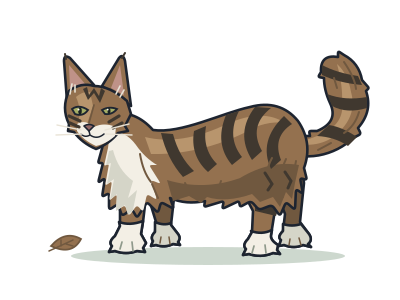
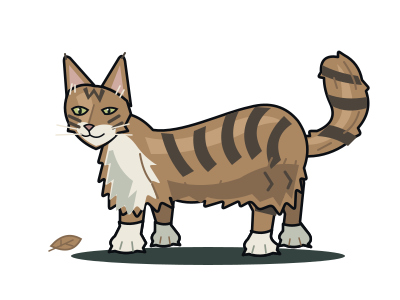
Its coat has two layers: woolly fur underneath longer, water-repellent outer hairs. In winter, a thick collar frames the neck, with longer fur around the hindquarters. Summer coats can be much shorter. A triangular head, straight nose and long, bushy tail help give the breed its recognisable outline. These cats develop slowly and may take about four to five years to finish growing.
Here, neighbouring breeds are browsing companions, not shown as ancestors and descendants. The editors arranged these groups using findings from a study of cats representing 41 breeds. This is not a family tree or a map of breed origins. Mixed ancestry and gaps in the cats studied limit what the groupings can tell us. The layout does not rule out documented crosses in individual breed histories.
Origins
The breed developed from local domestic cats in Norway.
Original purpose
Its working-cat background was on farms, where cats helped control rodents.
Recognition
FIFe, an international cat registry, recognised the breed in 1977. This was formal acceptance, not the date these cats originated.
Study attribution
Gandolfi et al. (2018), Scientific Reports 8:7024 · CC-BY-4.0. Original explanation of study-specific similarity; editorial group headings are explicitly not clades or geography of origin. No study photos imported.
CFA, TICA and GCCF breed histories. Original summaries of documented breeding programmes and registry distinctions. Per-page sources identify the relevant breed histories; no standards, source prose or photographs reproduced.
Gandolfi et al. (2010): Sphynx and Devon Rex mutations in KRT71. Independent factual explanation of distinct coat variants, not a breed pedigree. No source imagery or text reproduced.
Selection Signatures Reveal Candidate Genes for the Cornish Rex Breed-Specific Phenotype (2024). Factual contrast between LPAR6-associated Cornish coat and KRT71-associated Devon/Sphynx coats. No figures or measurements copied.
Selected facts/group membership adapted; simplified layout and illustrations by Lifetree.