A domestic breed
Oriental Longhair
Felis catus
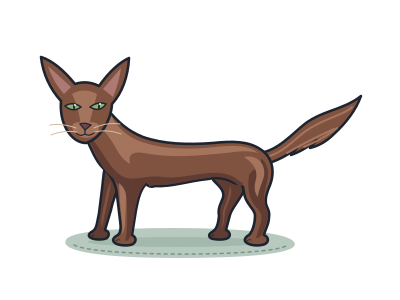
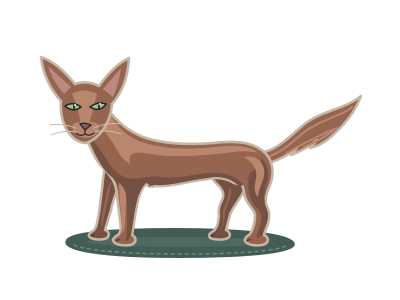
The long-coated Oriental, with a silky plume of a tail
Branches combine study-specific genetic affinities and documented breed-development histories. They are browsing groups, not a complete pedigree or dated evolutionary tree. Crossbreeding connects different branches, and similar coats can arise independently.
Return to the tree of life →The Oriental Longhair is the longer-coated counterpart of the Oriental Shorthair. Both have the long, slender build of the Siamese cats used to develop them. The head narrows from very large ears to the nose. Green is the preferred colour for the almond-shaped eyes, but some white cats have blue eyes. The silky coat lies close to the body, with the longest hairs fanning out along the tail.
The wider Oriental breeding programme began in England in the 1950s. Breeders crossed Siamese with other cats, including Russian Blues and British Shorthairs, then paired some of the offspring with Siamese again. The Cat Fanciers’ Association shows both coat lengths under one breed name, Oriental, in separate divisions. The International Cat Association lists Oriental Longhair and Oriental Shorthair as separate breeds.
The diagram places the Oriental Longhair beside breeds such as the Siamese and Balinese to help you explore. It does not show which breeds descended from which, or identify the Longhair’s closest genetic match.
Origins
In one recorded breeding programme, breeders crossed Balinese with Oriental Shorthairs in the late 1970s and 1980s. Longhaired kittens appeared in the second generation of those crosses.
Original purpose
Once breeders had developed a longer-haired Siamese, they set out to do the same for the Oriental Shorthair. They wanted to change the coat without changing the body shape.
Recognition
The International Cat Association records 1979 as the year the Oriental Longhair gained championship status. That is a show milestone, not the year the breed began.
Study attribution
Gandolfi et al. (2018), Scientific Reports 8:7024 · CC-BY-4.0. Original explanation of study-specific similarity; editorial group headings are explicitly not clades or geography of origin. No study photos imported.
CFA, TICA and GCCF breed histories. Original summaries of documented breeding programmes and registry distinctions. Per-page sources identify the relevant breed histories; no standards, source prose or photographs reproduced.
Gandolfi et al. (2010): Sphynx and Devon Rex mutations in KRT71. Independent factual explanation of distinct coat variants, not a breed pedigree. No source imagery or text reproduced.
Selection Signatures Reveal Candidate Genes for the Cornish Rex Breed-Specific Phenotype (2024). Factual contrast between LPAR6-associated Cornish coat and KRT71-associated Devon/Sphynx coats. No figures or measurements copied.
Selected facts/group membership adapted; simplified layout and illustrations by Lifetree.