A domestic breed
Balinese
Felis catus
A longhaired breed with Siamese roots, not a cat from Bali
Branches combine study-specific genetic affinities and documented breed-development histories. They are browsing groups, not a complete pedigree or dated evolutionary tree. Crossbreeding connects different branches, and similar coats can arise independently.
Return to the tree of life →The Balinese takes its name from dancers on Bali, not from the place where the breed began. Its Siamese connection continued after the first Balinese arrived in Britain in the 1970s. British breeders crossed them with Siamese again, helping shape the leaner build seen today.
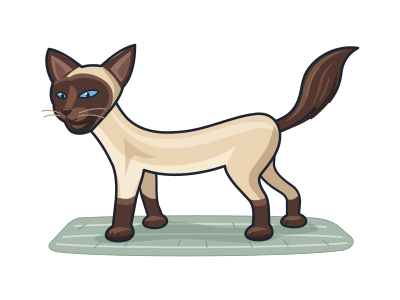
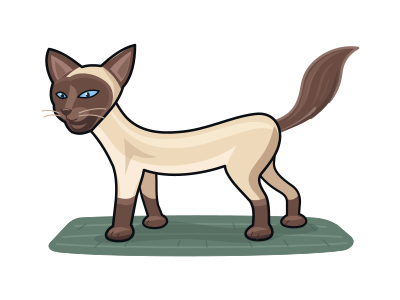
The fine, silky coat lies close to the body, with no thick, woolly layer underneath. The fur grows longest on the tail. A seal-point Balinese has a cream to light tan body and deep brown markings on the face, ears, legs, paws and tail.
The exhibit groups the Balinese with the Siamese because of their documented breeding history. A 2018 DNA study compared several nearby breeds but did not list the Balinese separately. The diagram is not a full family tree: being shown side by side does not tell you whether one breed came from another.
Origins
Marion Dorsey in California and Helen Smith in New York each found longhaired kittens in their Siamese litters and became early Balinese breeders.
Original purpose
Early breeders developed longhaired cats with the Siamese look for exhibition as a breed of their own. Helen Smith showed Balinese in the Any Other Variety class at New York’s Empire Cat Show.
Recognition
The Cat Fanciers’ Association admitted the Balinese to championship competition in 1970. That was a show milestone, not the year the breed began.
Study attribution
Gandolfi et al. (2018), Scientific Reports 8:7024 · CC-BY-4.0. Original explanation of study-specific similarity; editorial group headings are explicitly not clades or geography of origin. No study photos imported.
CFA, TICA and GCCF breed histories. Original summaries of documented breeding programmes and registry distinctions. Per-page sources identify the relevant breed histories; no standards, source prose or photographs reproduced.
Gandolfi et al. (2010): Sphynx and Devon Rex mutations in KRT71. Independent factual explanation of distinct coat variants, not a breed pedigree. No source imagery or text reproduced.
Selection Signatures Reveal Candidate Genes for the Cornish Rex Breed-Specific Phenotype (2024). Factual contrast between LPAR6-associated Cornish coat and KRT71-associated Devon/Sphynx coats. No figures or measurements copied.
Selected facts/group membership adapted; simplified layout and illustrations by Lifetree.