A domestic breed
Thai
Felis catus
A modern breed that keeps an older Siamese look
Branches combine study-specific genetic affinities and documented breed-development histories. They are browsing groups, not a complete pedigree or dated evolutionary tree. Crossbreeding connects different branches, and similar coats can arise independently.
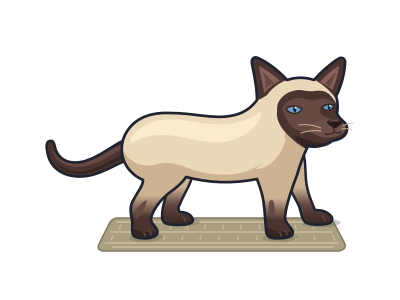
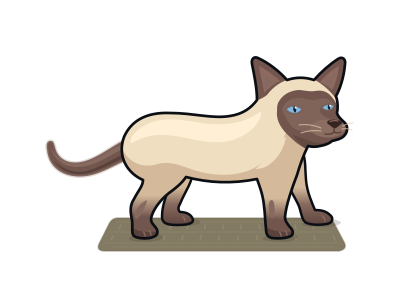
Return to the tree of life →Like the Siamese, the Thai has blue eyes and a short coat. The face, ears, lower legs, paws and tail are darker than the body. These markings are called points. Compared with the modern show Siamese, the Thai is bred for a softer wedge-shaped head, with rounded cheeks and a muzzle that sticks out and tapers to a rounded end.
When pointed cats from Siam, now Thailand, reached Britain in the 1800s, they became known there as Siamese. In the 1980s, clubs for old-style Siamese cats formed in Europe and North America. Breeders continued some of those Siamese lines and later brought in native pointed cats from Thailand. Both helped shape the modern Thai breed.
On this diagram, the Thai sits beside breeds such as the Siamese and Oriental Shorthair. The branch helps you browse. It doesn’t show which breeds were developed from which or tell you which breed is the Thai’s closest genetic relative.
Origins
The modern breed combines preserved old-style Siamese lines with pointed cats imported from Thailand. Historical Thai images document pointed cats, but do not trace a complete pedigree to today’s registered breed.
Original purpose
To keep the traditional shape, the World Cat Federation calls for a less elongated body than it does for the show Siamese. The International Cat Association used Harrison Weir’s 1889 sketches of Siamese cats as a reference for its own guide.
Recognition
The Thai could enter the International Cat Association’s championship classes from 1 May 2010. That was the start of its first championship season with that association, not the start of the breed.
Study attribution
Gandolfi et al. (2018), Scientific Reports 8:7024 · CC-BY-4.0. Original explanation of study-specific similarity; editorial group headings are explicitly not clades or geography of origin. No study photos imported.
CFA, TICA and GCCF breed histories. Original summaries of documented breeding programmes and registry distinctions. Per-page sources identify the relevant breed histories; no standards, source prose or photographs reproduced.
Gandolfi et al. (2010): Sphynx and Devon Rex mutations in KRT71. Independent factual explanation of distinct coat variants, not a breed pedigree. No source imagery or text reproduced.
Selection Signatures Reveal Candidate Genes for the Cornish Rex Breed-Specific Phenotype (2024). Factual contrast between LPAR6-associated Cornish coat and KRT71-associated Devon/Sphynx coats. No figures or measurements copied.
Selected facts/group membership adapted; simplified layout and illustrations by Lifetree.