A domestic breed
Standard Poodle
Canis lupus familiaris
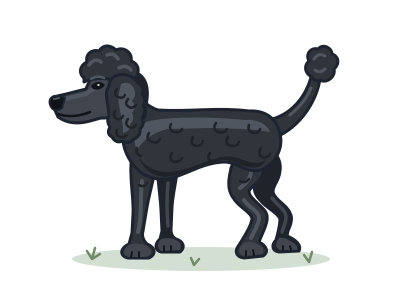
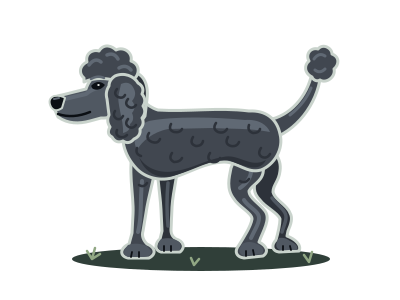
The biggest Poodle, beneath those famous curls.
Branches show genetic similarity, not direct ancestors or dated splits. Crossbreeding connects different branches.
Return to the tree of life →The Standard Poodle is the largest of the three Poodle sizes recognised in Britain and the United States. It is a variety of a domestic dog breed, not a separate species. Beneath its curls is a roughly square outline: its body length is about equal to its height at the shoulder.
Its long, straight muzzle has a definite chin. The coat can form dense curls or be arranged into hanging cords. In the Sporting haircut, the body hair follows the dog's outline. The face and feet are shaved, leaving a shaped cap of hair on the head and a puff on the tail. Those shapes are grooming, not extra body parts.
Here, the Standard Poodle sits in a study-specific group based on genetic similarity, near the Bichon Frise, Maltese and Havanese. This is not a family pedigree: none of those neighbouring modern breeds is presented as its ancestor.
Origins
The Royal Kennel Club traces the Poodle to Germany and earlier European water dogs, but accounts of its country of origin differ.
Original purpose
Early Poodles were water dogs used to bring back birds that people had hunted.
Recognition
The American Kennel Club recognised the Poodle in 1887. That is an official recognition date, not when the breed began.
Study attribution
Parker et al. (2017), Cell Reports 19:697–708 · CC-BY-4.0. Selected clade membership and nested Figure 1 relationships restated as a new, simplified diagram. No photographs, branch lengths or bootstrap values copied.
Selected facts/group membership adapted; simplified layout and illustrations by Lifetree.