A domestic breed
Bichon Frise
Canis lupus familiaris
A small dog with curls, a plumed tail and a carefully recorded modern history.
Branches show genetic similarity, not direct ancestors or dated splits. Crossbreeding connects different branches.
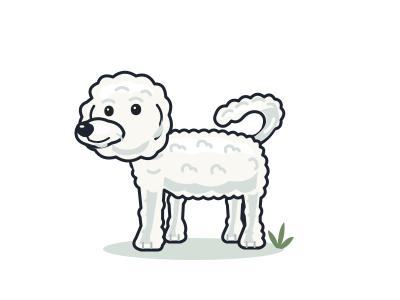
Return to the tree of life →The Bichon Frise is a small, sturdy dog breed with a white, curly coat and a feathery tail curved above its back. Its fluffy outline can hide its shape: the body is slightly longer than its shoulder height. The coat has two layers, with a soft, dense inner layer beneath a coarser, curlier outer one. Brushing helps create the familiar powder-puff outline.
Written records give clear landmarks in its development. Dogs named Pitou and Ida entered national breed registers in 1932 and 1934. The breed’s documented history also includes breeders rebuilding its population after the world wars. These records describe stages in its development, not a single moment when the breed began.
Here, it appears beside the Standard Poodle, Maltese and Havanese within the explorer’s Poodle group. This is a study-specific grouping based on genetic similarity, not a family pedigree. It does not mean that a modern Poodle—or any neighbouring breed—was the Bichon Frise’s ancestor.
Origins
The Kennel Club describes development in France, against a background of small companion dogs from the Mediterranean region.
Original purpose
These dogs were companions, including lapdogs in European royal courts. Work with street entertainers and circuses came later.
Recognition
The international kennel federation, FCI, formally accepted the breed in 1959. This was a registry decision, not the breed’s origin.
Study attribution
Parker et al. (2017), Cell Reports 19:697–708 · CC-BY-4.0. Selected clade membership and nested Figure 1 relationships restated as a new, simplified diagram. No photographs, branch lengths or bootstrap values copied.
Selected facts/group membership adapted; simplified layout and illustrations by Lifetree.