A domestic breed
Scottish Terrier
Canis lupus familiaris
Short legs, a sturdy body and a distinctive long head.
Branches show genetic similarity, not direct ancestors or dated splits. Crossbreeding connects different branches.
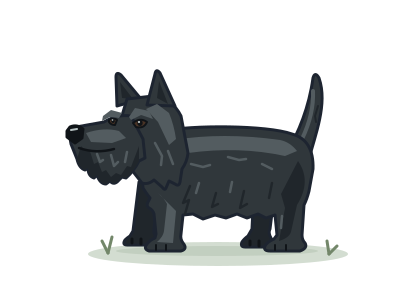
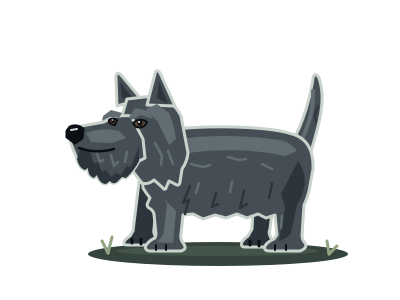
Return to the tree of life →The Scottish Terrier has a recognisable outline: a sturdy, compact body, short legs and a long head. Small, pointed ears stand naturally upright. Dark brown, almond-shaped eyes sit beneath prominent eyebrows. Beneath the beard is a substantial muzzle, roughly as long as the skull behind it.
Its deep chest sits between the front legs, below a short, level back. The front feet are slightly larger than the back feet. A tail that is thick at the base narrows towards the tip and is carried upright or with a slight bend.
Here, it appears beside the West Highland White Terrier, Cairn Terrier and Norwich Terrier in a study-specific similarity grouping. This is not a pedigree: neighbouring positions do not establish ancestor-and-descendant relationships. Nor does the layout rule out documented historical crosses or development from earlier breed stock. The browsing groups are not direct ancestors, and the diagram implies no dates or lengths of time between branches.
Origins
The breed developed in Scotland. Selective breeding and dog shows helped define its modern form in the late 1800s; Britain’s Kennel Club Stud Book first recorded it in 1880.
Original purpose
These terriers were bred to follow foxes, badgers and other animals into their underground shelters.
Recognition
The American Kennel Club recognised the breed in 1885. This was a registry milestone, not the breed’s beginning.
Study attribution
Parker et al. (2017), Cell Reports 19:697–708 · CC-BY-4.0. Selected clade membership and nested Figure 1 relationships restated as a new, simplified diagram. No photographs, branch lengths or bootstrap values copied.
Selected facts/group membership adapted; simplified layout and illustrations by Lifetree.