A domestic breed
Greenland Dog
Canis lupus familiaris
A Greenland sled dog bred for the long haul
Branches show genetic similarity, not direct ancestors or dated splits. Crossbreeding connects different branches.
Return to the tree of life →In Greenland, people chose dogs to breed for strength and for the ability to keep going over long distances in harsh Arctic conditions. Working teams still pull sleds over snow and sea ice when conditions allow.
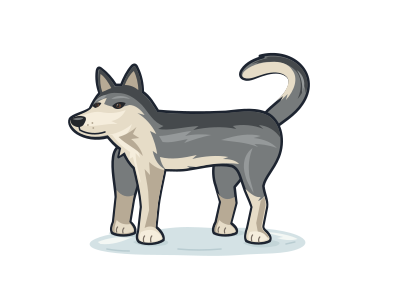
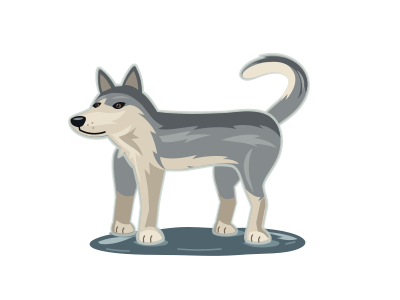
Look for a sturdy adult with a broad chest and a body a little longer than it is tall at the shoulder. The head is broad, with a strong snout that narrows gently and upright ears with slightly rounded tips. A thick tail curves loosely over the back. The coat has a soft, dense inner layer beneath coarse, straight outer hairs and comes in many colours.
The branches are based on similarities in the DNA of dogs in a 2017 study. They do not show one breed as the ancestor of another or tell us when breeds split. Crossbreeding can connect breeds on different branches, and the diagram does not show that full history.
Origins
Inuit kept the sled dogs behind this breed in Greenland for centuries. A 2025 study found evidence that their ancestors came with Inuit from what is now Arctic Canada in two waves.
Original purpose
Inuit used these dogs to pull sleds for transport and to help with hunting.
Recognition
The international dog federation, known as the FCI, gave the breed full recognition on 5 May 1967. Its register lists Greenland as the place of origin and Denmark as responsible for the official breed description. That date marks recognition, not the start of the sled-dog tradition.
Study attribution
Parker et al. (2017), Cell Reports 19:697–708 · CC-BY-4.0. Selected clade membership and nested Figure 1 relationships restated as a new, simplified diagram. No photographs, branch lengths or bootstrap values copied.
Selected facts/group membership adapted; simplified layout and illustrations by Lifetree.