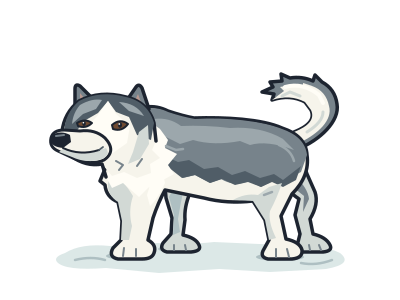
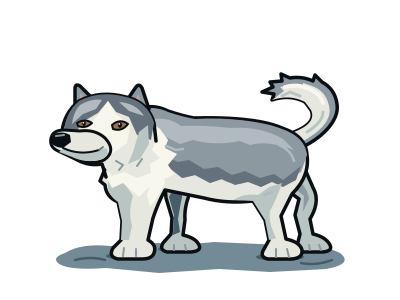
A domestic breed
Alaskan Malamute
Canis lupus familiaris
A broad-headed, thick-coated member of the dog family
Branches show genetic similarity, not direct ancestors or dated splits. Crossbreeding connects different branches.
Return to the tree of life →The Alaskan Malamute is recognisable by its broad head, substantial muzzle and thick coat. It is a domestic dog breed, not a separate species. Here it appears beside the Akita, Shiba Inu and Siberian Husky in a grouping based on genetic similarities found in one study. Their positions do not establish which breeds contributed to the Malamute’s history.
Its coat has coarse outer hairs over dense, woolly underfur that helps protect against Arctic cold. Grey, black or red can appear with white underneath and on parts of the face and legs. Some dogs are entirely white. Natural facial markings may look like a coloured cap, a mask, or both.
The American breed club documents three breeding lines involved in modern breed development: Kotzebue, M’Loot and Hinman, also called Hinman-Irwin. Milton and Eva Seeley developed the Kotzebue line at Chinook Kennels in New Hampshire. These accounts describe the breed’s development, not genetic relationships to the other breeds shown nearby.
Origins
The breed takes its name from the Mahlemut Inuit people of the Kotzebue Sound area in north-western Alaska.
Original purpose
These dogs were developed to pull heavy loads over long distances.
Recognition
The American Kennel Club recognised the breed in 1935. This marks official recognition, not the beginning of its working-dog history.
Study attribution
Parker et al. (2017), Cell Reports 19:697–708 · CC-BY-4.0. Selected clade membership and nested Figure 1 relationships restated as a new, simplified diagram. No photographs, branch lengths or bootstrap values copied.
Selected facts/group membership adapted; simplified layout and illustrations by Lifetree.