A domestic breed
Curly-Coated Retriever
Canis lupus familiaris
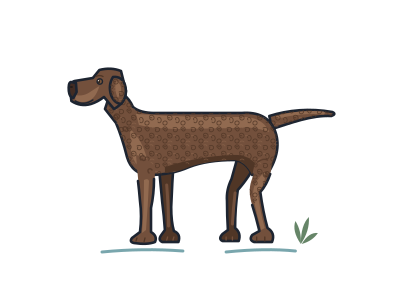
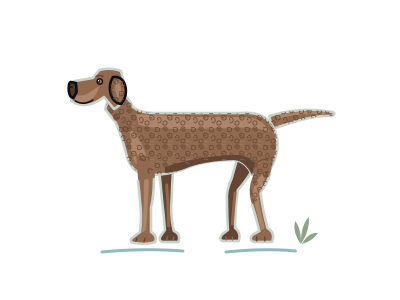
A retriever with close-packed curls and a smooth-haired face.
Branches show genetic similarity, not direct ancestors or dated splits. Crossbreeding connects different branches.
Return to the tree of life →Small, tight curls make the Curly-Coated Retriever stand out beside the Labrador, Golden and Flat-Coated Retrievers shown here. The curls lie close to the skin rather than making a fluffy outline. But they do not cover everything: the face, fronts of the forelegs and feet have short, smooth hair.
Look beyond the coat and you will see a long, strong snout and small ears that hang close to the head. The body is slightly longer than its shoulder height, with a deep chest and level back. Even the fairly straight tail carries curls. The dense coat helps protect a working dog from water, rough plants and bad weather.
These neighbouring breeds sit together in a study-specific similarity grouping. The diagram does not show one neighbouring breed as the ancestor of another. Its browsing groups are not direct ancestors, and it gives no dates for when breeds separated. Documented breed history is a separate kind of evidence.
Origins
The breed originated in England and was exhibited at Birmingham in 1860. That show records its existence, not the beginning of its development.
Original purpose
Gamekeepers developed these dogs to find and bring back hunted birds, both on land and from water.
Recognition
The American Kennel Club recognised the breed in 1924. This was a registry milestone, not its origin date.
Study attribution
Parker et al. (2017), Cell Reports 19:697–708 · CC-BY-4.0. Selected clade membership and nested Figure 1 relationships restated as a new, simplified diagram. No photographs, branch lengths or bootstrap values copied.
Selected facts/group membership adapted; simplified layout and illustrations by Lifetree.