A domestic breed
Border Collie
Canis lupus familiaris
A familiar working dog with more than one look
Branches show genetic similarity, not direct ancestors or dated splits. Crossbreeding connects different branches.
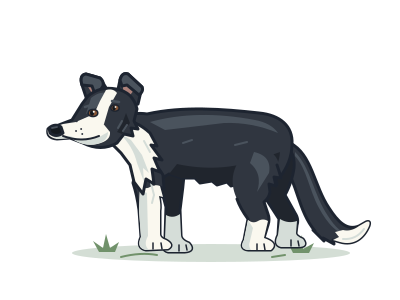
Return to the tree of life →The Border Collie has a recognisable outline, but no single look fits every dog. Its athletic body is slightly longer than it is tall at the shoulder. A strong muzzle tapers towards the nose, and the medium-sized ears may stand upright or fold at their tips. The eyes are oval and moderately sized.
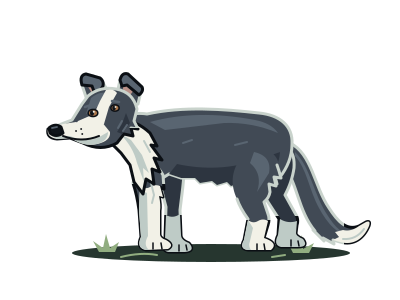
Some have short, smooth coats; others have moderately long coats. Both coat types have a dense outer layer and a soft, dense layer underneath. These differences belong within the same breed, not separate species.
Here, the Border Collie appears beside the Collie, Shetland Sheepdog and Australian Shepherd in a study-specific grouping based on genetic similarity. This is not a pedigree, or family tree of individual dogs. Neighbouring breeds are not presented as ancestors and descendants. The browsing groups are not direct ancestors either. The layout gives no dates for separations or time scales along its branches. It does not establish or rule out historical crosses or development from earlier breed stock.
Origins
The breed developed in the border country between Scotland and England, where shepherds selected dogs for working ability across rough ground.
Original purpose
Border Collies were bred to help shepherds manage sheep, including on difficult hills and farmland.
Recognition
The American Kennel Club recognised the breed in 1995. That marked official registration, not the breed’s beginning.
Study attribution
Parker et al. (2017), Cell Reports 19:697–708 · CC-BY-4.0. Selected clade membership and nested Figure 1 relationships restated as a new, simplified diagram. No photographs, branch lengths or bootstrap values copied.
Selected facts/group membership adapted; simplified layout and illustrations by Lifetree.