A domestic breed
Australian Shepherd
Canis lupus familiaris
An Australian name, an American breed
Branches show genetic similarity, not direct ancestors or dated splits. Crossbreeding connects different branches.
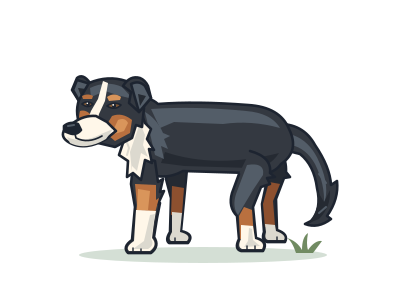
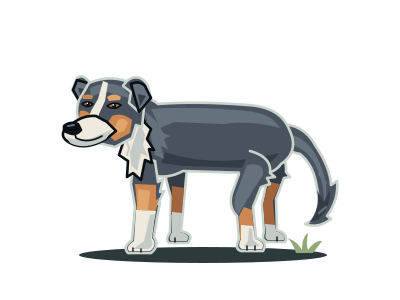
Return to the tree of life →Look for triangular ears with tips that fold forwards or sideways, rather than standing fully upright. The substantial snout narrows gently towards a rounded tip. White markings may form a collar around the neck, a chest patch, a stripe on the face and patches on the legs. In the breed-standard appearance, white does not dominate the head.
The Australian Shepherd appears beside the Border Collie, Collie and Shetland Sheepdog in this tree. That placement reflects genetic similarity found in one study. It does not show these neighbouring breeds as its ancestors or descendants. The browsing group called “UK rural” is not an ancestor either. This is a domestic dog breed, not a separate species.
An adult stands roughly half a metre tall at the shoulder, rather than at the top of the head. Males are generally larger than females. Breed standards offer guides to size and appearance; they do not describe every individual exactly.
Origins
Despite its name, the breed was developed in the western United States, including California, Colorado, Wyoming and Idaho.
Original purpose
It was developed as an all-round farm and ranch dog, moving sheep and cattle between grazing grounds and through yards and narrow passages.
Recognition
The American Kennel Club recognised the breed in September 1991. Admission to its Herding Group followed in January 1993. Neither date marks the breed’s origin.
Study attribution
Parker et al. (2017), Cell Reports 19:697–708 · CC-BY-4.0. Selected clade membership and nested Figure 1 relationships restated as a new, simplified diagram. No photographs, branch lengths or bootstrap values copied.
Selected facts/group membership adapted; simplified layout and illustrations by Lifetree.