A domestic breed
Somali
Felis catus
Long-haired kittens from Abyssinian lines
Branches combine study-specific genetic affinities and documented breed-development histories. They are browsing groups, not a complete pedigree or dated evolutionary tree. Crossbreeding connects different branches, and similar coats can arise independently.
Return to the tree of life →Short-haired Abyssinians sometimes had long-haired kittens. A kitten can have long fur even when both parents have short fur, if it inherits a long-hair version of a gene from each parent. The Somali breed took shape in North America. Its name refers to Somalia, which borders Ethiopia, once called Abyssinia.
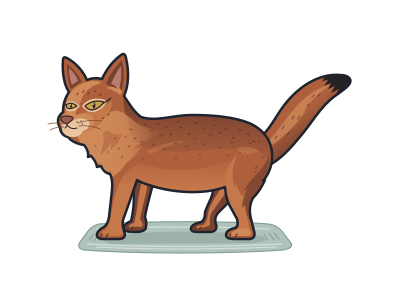
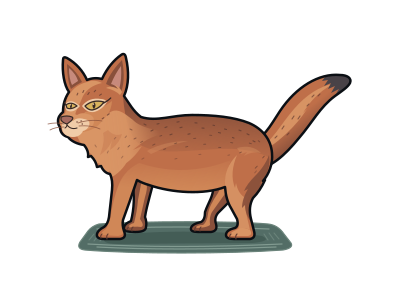
Both breeds have ticked fur. Light and dark bands on individual hairs give the coat a softly shaded look rather than broad stripes. In the colour called ruddy, the fur is warm reddish-brown with dark bands. The long-haired Somali has fuller fur around its neck and a bushy tail like a feather. It has a supple, muscular body and large ears that are wide at the base.
The two breeds sit side by side here because of their documented breeding history. Being next to each other does not, by itself, show that one breed came from the other. The diagram helps you browse breeds; it does not trace every cross or show when breeds developed.
Origins
American breeder Evelyn Mague worked with Canadian breeder Don Richings to develop the Somali.
Original purpose
Some Abyssinian breeders tried to avoid long coats. Early Somali breeders kept the longer coat and worked to have their cats accepted at shows as a breed of their own.
Recognition
The Cat Fanciers’ Association first let Somalis compete for championships in 1979. That was a show milestone, not the start of the breed. The Fédération Internationale Féline also recognises the Somali.
Study attribution
Gandolfi et al. (2018), Scientific Reports 8:7024 · CC-BY-4.0. Original explanation of study-specific similarity; editorial group headings are explicitly not clades or geography of origin. No study photos imported.
CFA, TICA and GCCF breed histories. Original summaries of documented breeding programmes and registry distinctions. Per-page sources identify the relevant breed histories; no standards, source prose or photographs reproduced.
Gandolfi et al. (2010): Sphynx and Devon Rex mutations in KRT71. Independent factual explanation of distinct coat variants, not a breed pedigree. No source imagery or text reproduced.
Selection Signatures Reveal Candidate Genes for the Cornish Rex Breed-Specific Phenotype (2024). Factual contrast between LPAR6-associated Cornish coat and KRT71-associated Devon/Sphynx coats. No figures or measurements copied.
Selected facts/group membership adapted; simplified layout and illustrations by Lifetree.