A domestic breed
Abyssinian
Felis catus
A ticked coat, a long-haired counterpart and a history beyond the name
These are editorial browsing groups, informed by Gandolfi et al. 2018 genetic-structure analyses. They are not rooted clades, direct ancestry, or a map of breed origins. Admixture and incomplete sampling limit every grouping.
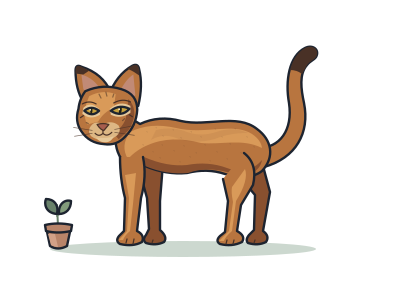
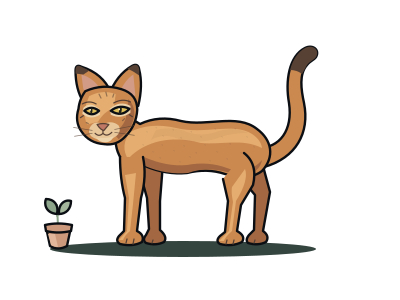
Return to the tree of life →The Abyssinian is a domestic cat breed, not a separate species. The Somali developed as its long-haired counterpart, sharing its distinctive coat pattern. That pattern is called ticked: individual hairs carry alternating light and dark bands, rather than forming large spots.
A slender, muscular body, large upright ears and a long, narrowing tail help give the Abyssinian its recognisable outline. Its small oval feet sit beneath moderately slim legs. Some individuals have little tufts at their ear tips.
The Abyssinian and Somali share a branch because the Somali developed from longhaired kittens in Abyssinian lines. Their wider placement preserves the 2018 study’s intermediate affinities, alongside Turkish Angora and Turkish Van. That study does not turn all these breeds into one documented lineage. Early Abyssinian pedigrees also included unknown parents and crosses with cats unlike today’s breed.
Origins
The modern breed was developed and refined in Britain. Its name does not establish an Ethiopian birthplace.
Original purpose
The recorded development points to a companion and show breed, selected for its appearance. This is an interpretation of the history, not proof of its earliest role.
Recognition
The Governing Council of the Cat Fancy recognised the Abyssinian in 1929. This was a registry milestone, not the breed's origin date.
Study attribution
Gandolfi et al. (2018), Scientific Reports 8:7024 · CC-BY-4.0. Original explanation of study-specific similarity; editorial group headings are explicitly not clades or geography of origin. No study photos imported.
CFA, TICA and GCCF breed histories. Original summaries of documented breeding programmes and registry distinctions. Per-page sources identify the relevant breed histories; no standards, source prose or photographs reproduced.
Gandolfi et al. (2010): Sphynx and Devon Rex mutations in KRT71. Independent factual explanation of distinct coat variants, not a breed pedigree. No source imagery or text reproduced.
Selection Signatures Reveal Candidate Genes for the Cornish Rex Breed-Specific Phenotype (2024). Factual contrast between LPAR6-associated Cornish coat and KRT71-associated Devon/Sphynx coats. No figures or measurements copied.
Selected facts/group membership adapted; simplified layout and illustrations by Lifetree.