A domestic breed
Oriental Shorthair
Felis catus
A Siamese-style outline with its own breed identity
These are editorial browsing groups, informed by Gandolfi et al. 2018 genetic-structure analyses. They are not rooted clades, direct ancestry, or a map of breed origins. Admixture and incomplete sampling limit every grouping.
Return to the tree of life →The Oriental Shorthair shares its distinctive outline with the Siamese. The cat registry TICA groups it with Siamese, Balinese and Oriental Longhair cats. Their official descriptions differ mainly in coat length and colour. The Oriental Longhair is its longer-coated counterpart, not another name for the short-coated breed.
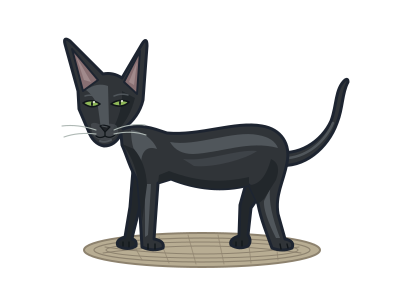
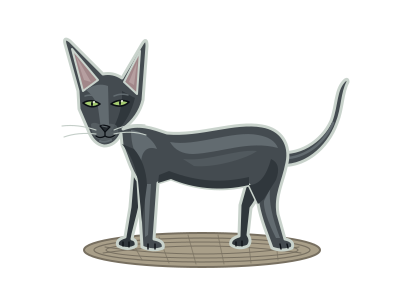
This is a long, narrow cat with fine bones and firm muscles. Its slender shape should not be mistaken for an exposed skeleton. Think of a lean, muscular adult rather than a tiny kitten: the breed’s stretched outline is part of its appearance.
This branch compares the four Siamese-group breeds with Thai and Peterbald. The wider Eastern grouping retains the genetic study context. Its branching order does not trace every cross or rank the breeds’ closest relatives.
Origins
Developed in England in the 1950s, using Siamese cats crossed with other domestic cats, according to TICA.
Original purpose
Early breeding programmes sought Siamese-style cats in new coat colours. GCCF records one British programme aimed at producing a solid chocolate-brown cat.
Recognition
The Cat Fanciers’ Association accepted Oriental Shorthairs for registration in 1974 and championship competition in 1977. These are recognition dates, not origin dates.
Study attribution
Gandolfi et al. (2018), Scientific Reports 8:7024 · CC-BY-4.0. Original explanation of study-specific similarity; editorial group headings are explicitly not clades or geography of origin. No study photos imported.
CFA, TICA and GCCF breed histories. Original summaries of documented breeding programmes and registry distinctions. Per-page sources identify the relevant breed histories; no standards, source prose or photographs reproduced.
Gandolfi et al. (2010): Sphynx and Devon Rex mutations in KRT71. Independent factual explanation of distinct coat variants, not a breed pedigree. No source imagery or text reproduced.
Selection Signatures Reveal Candidate Genes for the Cornish Rex Breed-Specific Phenotype (2024). Factual contrast between LPAR6-associated Cornish coat and KRT71-associated Devon/Sphynx coats. No figures or measurements copied.
Selected facts/group membership adapted; simplified layout and illustrations by Lifetree.