A domestic breed
American Shorthair
Felis catus
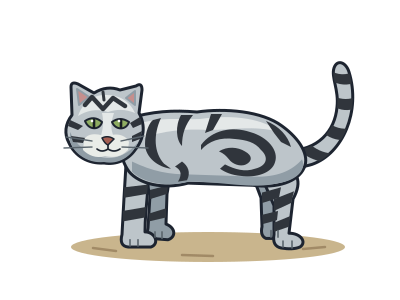
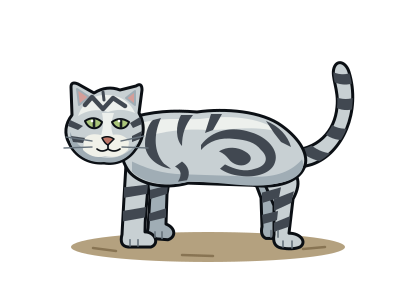
A familiar-looking cat with a carefully developed breed identity.
These are editorial browsing groups, informed by Gandolfi et al. 2018 genetic-structure analyses. They are not rooted clades, direct ancestry, or a map of breed origins. Admixture and incomplete sampling limit every grouping.
Return to the tree of life →The American Shorthair belongs among domestic-cat breeds, but a similar-looking household cat does not necessarily belong to this breed. Breeders deliberately selected cats for a consistent appearance. Describing it as a natural breed does not mean people played no part in shaping it.
Look for a substantial, square-looking muzzle, a strong chin and medium-sized ears with gently rounded tips. The head is slightly longer than it is wide. The eyes are set well apart, with outlines that are not perfectly round. Breed descriptions put full physical maturity at about three to four years.
Its position here is a browsing aid, not a family pedigree. Nearby breeds are not shown as its ancestors, descendants or closest relatives, and the layout does not map where breeds originated. This limitation does not deny documented historical crosses or development from earlier breed stock. Breed history needs its own evidence, rather than being read from neighbouring names.
Origins
The breed developed in North America from domestic cats brought from Europe. Its history also includes later imports from England.
Original purpose
Its early working-cat stock hunted rodents aboard settlers’ ships, helping protect stored food.
Recognition
The Cat Fanciers’ Association recognised the breed at its founding in 1906. That recognition was not the beginning of its history.
Study attribution
Gandolfi et al. (2018), Scientific Reports 8:7024 · CC-BY-4.0. Original explanation of study-specific similarity; editorial group headings are explicitly not clades or geography of origin. No study photos imported.
CFA, TICA and GCCF breed histories. Original summaries of documented breeding programmes and registry distinctions. Per-page sources identify the relevant breed histories; no standards, source prose or photographs reproduced.
Gandolfi et al. (2010): Sphynx and Devon Rex mutations in KRT71. Independent factual explanation of distinct coat variants, not a breed pedigree. No source imagery or text reproduced.
Selection Signatures Reveal Candidate Genes for the Cornish Rex Breed-Specific Phenotype (2024). Factual contrast between LPAR6-associated Cornish coat and KRT71-associated Devon/Sphynx coats. No figures or measurements copied.
Selected facts/group membership adapted; simplified layout and illustrations by Lifetree.